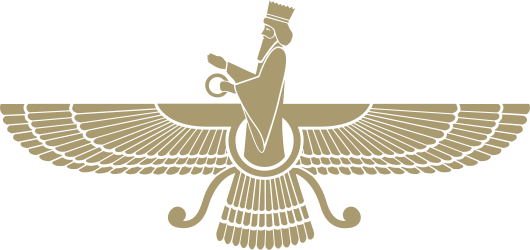
Faravahar: The Eternal Symbol of Iran
The Faravahar (also spelled Farohar, Fravashi, or Fravahar) is one of Iran's oldest and most recognizable symbols, with a history spanning over 2,500 years. This winged figure, prominently displayed at Persepolis, Naqsh-e Rostam, and countless other ancient Iranian sites, has become the quintessential symbol of Iranian identity and Zoroastrian faith.
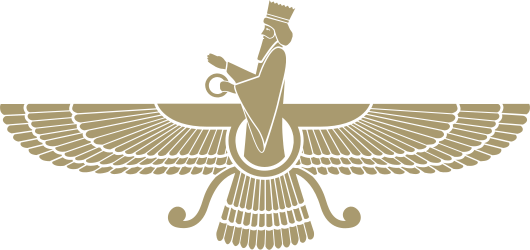
Why is Faravahar Our App's Emblem?
The Gahshomar app uses the Faravahar as its emblem for several meaningful reasons:
1. Connection to Ancient Heritage
The Imperial Calendar that this app preserves takes its epoch from the coronation of Cyrus the Great (559 BCE)—the very era when the Faravahar was the official symbol of the Achaemenid Empire.2. Symbol of Eternity
The word "Faravahar" means "eternal soul." Just as the Faravahar represents the immortality of the soul, calendar-keeping is the eternal recording of time.3. Ethical Values
The Faravahar symbolizes Good Thoughts, Good Words, Good Deeds—the values upon which Iranian culture was built.4. Universal Iranian Identity
The Faravahar is a symbol that all Iranians, regardless of religion or belief, recognize as their shared heritage.Etymology and Meaning
Word Origins
| Language | Word | Meaning |
| Avestan | Fravashi | Guardian Spirit |
| Pahlavi | Fravahar | Eternal Soul |
| Modern Persian | Faravahar / Farr | Divine Glory |
The Concept of Fravashi in the Avesta
In Avestan texts, Fravashis are guardian spirits:
- Pre-birth soul: Every human has a Fravashi before being born
- Life protector: The Fravashi protects a person throughout life
- Eternal after death: After death, the Fravashi returns to the spiritual realm
Farr (Khvarenah) - Divine Glory
The concept of Farr or Khvarenah is crucial in Iranian culture:
- Royal Farr: Divine power bestowed upon kings
- Divine Glory: Heavenly blessing and majesty
- Symbol of Legitimacy: Just rulers possessed Farr
Components of the Faravahar Symbol
The Faravahar consists of several parts, each carrying symbolic meaning:
1. The Human Figure
| Part | Symbol |
| Head | Wisdom and thought |
| Long beard | Maturity and knowledge |
| Right hand (raised) | Pointing toward Ahura Mazda |
| Left hand | Ring of covenant or ring of eternity |
2. The Wings
The spread wings symbolize:
- Three rows of feathers: Good Thoughts, Good Words, Good Deeds
- Flight: The soul's ascent toward perfection
- Protection: Sheltering the followers of truth
3. The Central Ring
The circle from which the figure emerges:
- Eternal cycle: Symbol of the soul's beginningless and endless nature
- Ahura Mazda: Representing the one God
- Unity: Oneness of the soul with the Divine
4. The Tail
The three-part tail at the bottom:
- Three sections: Bad thoughts, bad words, bad deeds (which must be abandoned)
- Balance: The equilibrium between good and evil in the world
5. The Two Streamers
Two ribbons extending from the ring:
- Spenta Mainyu: The holy spirit (goodness)
- Angra Mainyu: The destructive spirit (evil)
- Choice: Symbolizing human free will in choosing between good and evil
Historical Background
The Achaemenid Era (550-330 BCE)
The Faravahar reached its peak prominence during the Achaemenid period:
| Location | Description |
| Persepolis | On palace doorways and rock reliefs |
| Naqsh-e Rostam | On royal tombs |
| Bisotun | In Darius the Great's inscription |
| Pasargadae | At Cyrus's tomb |
Various Interpretations
Scholars have proposed different meanings for the Achaemenid Faravahar:
- Symbol of Ahura Mazda: Some see it as a direct representation of God
- Royal Farr: The divine power bestowed upon the king
- Ancestral spirits: Souls of past kings protecting the ruler
- Religio-political symbol: A combination of all these meanings
More Ancient Origins
The Faravahar likely evolved from older symbols:
| Civilization | Similar Symbol |
| Ancient Egypt | Winged sun disk |
| Assyria | Ashur (national deity) |
| Babylon | Shamash (sun god) |
However, the Iranian Faravahar, with its added human figure, acquired a unique meaning.
Faravahar in Zoroastrianism
Symbol of Zoroastrian Faith
Today, the Faravahar is the most important symbol of Zoroastrianism:
- Fire temples: Displayed at the entrance of all fire temples
- Religious ceremonies: Used in festivals and rituals
- Zoroastrian identity: Badge of belonging to this faith
Farvardingan Festival
19 Farvardin is the festival of the Fravashis:
- Honoring departed souls
- Remembering ancestors
- Decorating tombs and gravesites
The Three Fundamental Principles
The Faravahar reminds us of three Zoroastrian principles:
| Persian | Avestan | Meaning |
| Pendar-e Nik | Humata | Good Thoughts |
| Goftar-e Nik | Hukhta | Good Words |
| Kerdar-e Nik | Hvarshta | Good Deeds |
Faravahar in Art and Culture
Architecture
The Faravahar holds a special place in Iranian architecture:
- Building entrances: Especially in Zoroastrian areas
- Museums: Symbol of cultural heritage
- Memorials: In sculptures and monuments
Jewelry
The Faravahar is one of the most popular motifs in Iranian jewelry:
- Necklaces
- Rings
- Bracelets
- Earrings
Visual Arts
- Painting: In classical and contemporary works
- Sculpture: In metal, stone, and wood
- Graphic design: In logos and emblems
Faravahar and Iranian Identity
National Symbol
The Faravahar has transcended its religious origins to become a symbol of Iranian identity:
- All Iranians: Muslim, Zoroastrian, Jewish, Christian, and others
- Iranian diaspora: A symbol connecting them to Iran
- Global recognition: Known throughout the world
Shared Heritage
The Faravahar reminds us of an era when Iran:
- Was the world's greatest empire
- Was a cradle of civilization and culture
- Championed human values
The Faravahar's Message for Today
The Faravahar carries eternal messages:
1. Human Free Will
Humans are free to choose between good and evil.2. Personal Responsibility
Each person is responsible for their own thoughts, words, and deeds.3. Immortality of the Soul
The human soul is eternal and lives on through good works.4. Connection to the Past
We are heirs to an ancient and rich civilization.---
The Faravahar, this winged figure that emerged from the heart of Iranian history, now adorns the emblem of the Gahshomar app as a reminder of our connection to our ancient heritage. Each time you gaze upon this symbol, remember that you are the heir to a 2,500-year-old civilization—one that championed human values, wisdom, and goodness.
The choice of the Faravahar for our app is not merely aesthetic; it is a statement of purpose. Just as the Faravahar watches over the souls of humanity, the Imperial Calendar watches over the continuity of Iranian civilization, marking each day as a thread in the tapestry of a story that began when Cyrus first wore the crown of Persia.